List of Companies
The list of companies consists of the entire list of items (companies,
exchange rates, inflation indices, interest rates, etc.) available in
the database. This list is shown in the Stock
Guide (see chapter StockGuide)
and in the Speed Search box when
changing the current company (see chapter Basic
Structure > Change Company).
This chapter is comprised of the topics listed below. Click on the desired
topic to move automatically to its corresponding description.
Names
in red
Companies
with more than one share class and shares registered in more than one
stock exchange
Dollar,
inflation indices, interest reates, stock indices, etc.
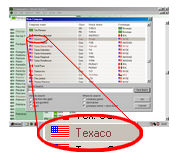 Names
in red : The company names in red are those of companies that are
no longer listed in the exchange (companies in bankruptcy, or that have
dissolved, etc.). These companies are kept in the database for users interested
in certain types of historical analysis. In addition to the red color,
these companies are also identified by the field Active/Cancelled
in the Company Registration window
(consult the chapter Company Registration
> Active/Cancelled ).
Names
in red : The company names in red are those of companies that are
no longer listed in the exchange (companies in bankruptcy, or that have
dissolved, etc.). These companies are kept in the database for users interested
in certain types of historical analysis. In addition to the red color,
these companies are also identified by the field Active/Cancelled
in the Company Registration window
(consult the chapter Company Registration
> Active/Cancelled ).
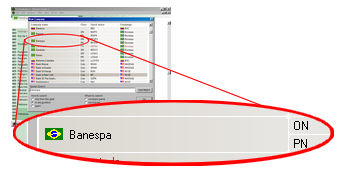 Companies
with more than one share class and shares registered in more than one
stock exchange: For those companies with more than one share class,
the company name appears once in a double-height cell and the column to
the right shows the respective share classes.
Companies
with more than one share class and shares registered in more than one
stock exchange: For those companies with more than one share class,
the company name appears once in a double-height cell and the column to
the right shows the respective share classes.
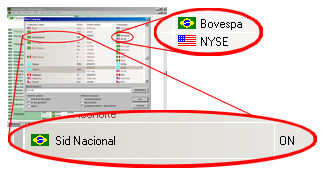 In cases in which company shares are traded in more than
one stock exchange, the company name and the share class appear once in
double-height cells while data in each row corresponds to each of the
stock exchanges. The adjacent window shows the company Sid Nacional whose
shares (ON class) are traded at the Bovespa exchange (Brazil) and NYSE
(USA).
In cases in which company shares are traded in more than
one stock exchange, the company name and the share class appear once in
double-height cells while data in each row corresponds to each of the
stock exchanges. The adjacent window shows the company Sid Nacional whose
shares (ON class) are traded at the Bovespa exchange (Brazil) and NYSE
(USA).
And how would the displayed information differ if, for example, the
current company was Banespa ON or Banespa PN (or Sid Nacional ON - Bovespa
and Sid Nacional ON - NYSE)?
Before we answer this question, it is important to note that there are
certain data types that refer exclusively to the company while there are
others that refer to (or are derived from) the shares. The data that refers
to the company are the financial statement items, financial ratios and
shareholders while stock prices, trading ratios, technical indicators
and corporate actions refer to the company shares.
The data that refers to the company are the financial statement items,
financial ratios, shareholders and certain company registration items
while stock prices, trading ratios, technical indicators, corporate
actions and certain company registration items refer to the company shares.
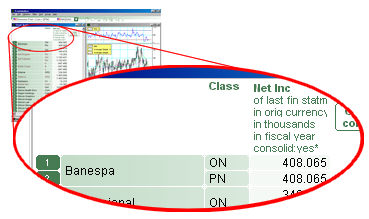 The data of the first type would be identical across all
share classes of any given company. The image on the side shows (via a
Stock Guide column, see chapter Stock Guide)
that net income (data of the first type) is the same for all the share
classes of Banespa
The data of the first type would be identical across all
share classes of any given company. The image on the side shows (via a
Stock Guide column, see chapter Stock Guide)
that net income (data of the first type) is the same for all the share
classes of Banespa
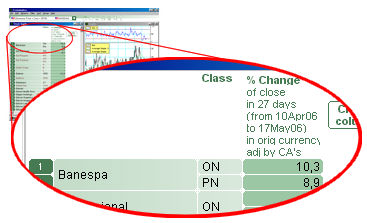 On the other hand, data of the second type would be different
for each of the share classes of any given company. The adjacent image
(via a Stock Guide column, see chapter Stock
Guide) that the share valuation (data of the second type) is different
for each share of Banespa.
On the other hand, data of the second type would be different
for each of the share classes of any given company. The adjacent image
(via a Stock Guide column, see chapter Stock
Guide) that the share valuation (data of the second type) is different
for each share of Banespa.
In the chapter StockGuide > Eliminating
repeated companies you will find instructions on how to display
only one instance of each company in the Stock Guide.
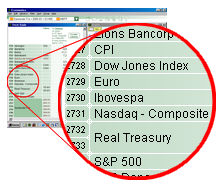 Dollar,
inflation indices, interest reates, stock indices, etc: At the
bottom of the list of companies you will find other items such as stock
indices, foreign exchange rates, inflation indices, etc.
Dollar,
inflation indices, interest reates, stock indices, etc: At the
bottom of the list of companies you will find other items such as stock
indices, foreign exchange rates, inflation indices, etc.
The system offers only pricing and technical indicators for these items.
Data such as financial statements, financial ratios, trading ratios, corporate
actions and shareholders is not relevant and will not be displayed. To
learn how to identify these items refer to the chapter Company
Registration > Type of Asset.