Below are the characteristics of the Financial Statements data as presented in the Economatica system.
Contents: Financial statements consist of the following components: Assets, Liabilities, Income Statement, Cash Flow Statement or Source and Use of Funds Statement, and Shares Outstanding.
Data Source: Economatica collects financial statements from exchange commissions and stock exchanges.
Timely: Economatica will disseminate financial statements within a 24-hour period once the financial statements are released by the primary source. In certain cases, the turnaround time may be under one hour, and in some exceptional cases, the turnaround may be over 1 day.
Reporting Frequency: Economatica will capture 4 financial statements per year; one annual and three quarterly reports (exceptions)
Historical Information: The start of the historical financial statement database varies across the countries. The Brazilian financial statements start at the earliest, 1986, whereas the history of the most recent country is 1997.
Accounts Template : Economatica reproduces the financial statements templates exactly as provided by the countries' exchange commissions. (exceptions)
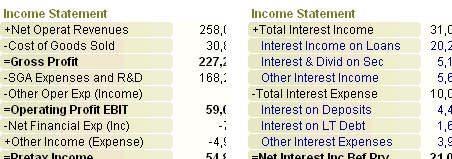
Reporting Format: the financial statement formats vary across countries and across industries within countries (industrials, banks, insurance, etc.). To help illustrate these differences, the picture below shows a side-by-side comparison between the template of a USA industrial (left) and of a USA bank (right) .
Currency: the default values are in the local currency of the companies' country of origin. However, you may convert the values into other currencies, adjust for inflation, etc.
Consolidated: the database consists of both consolidated and unconsolidated financial statements (exception). The financial statement format is identical in each case, therefore it will be obligatory for certain line items to be zero, for example the minority interest line in the unconsolidated reports.